Independent Designer Pricing: What You Actually Pay For
Quick Summary
Independent designer pieces cost more because they are made in small batches, often by hand, from better materials, and skilled labor costs more per unit than factory production built for volume. Each price layer, including materials, labor, sampling, and overhead, is spread across fewer pieces, which raises the price a shopper pays.
- Small labels lose bulk fabric discounts that large retailers negotiate.
- Hand-finished details like French seams and hand-set linings take hours of skilled labor.
- Design and sampling costs are spread across a few dozen pieces instead of thousands.
- Check fabric content, seam finishing, and interlining before judging whether a price is justified.
- Estimate cost per wear honestly, and set your expected wear count before looking at the price.
Table of Contents
- Why Independent Designer Pieces Cost More Than Mass-Market Fashion
- A Transparent Breakdown of a Garment's Retail Price
- How Much Handcrafted Clothes Cost to Make and Why It Varies
- Independent Designer Fashion vs Luxury Fashion: Where the Price Differs
- Using a Clothing Markup Calculator and Judging Value Before You Buy
- Booking a Concierge Consultation to Find Pieces That Justify the Price
- Frequently Asked Questions
Why Independent Designer Pieces Cost More Than Mass-Market Fashion
Last Updated: November 8, 2026
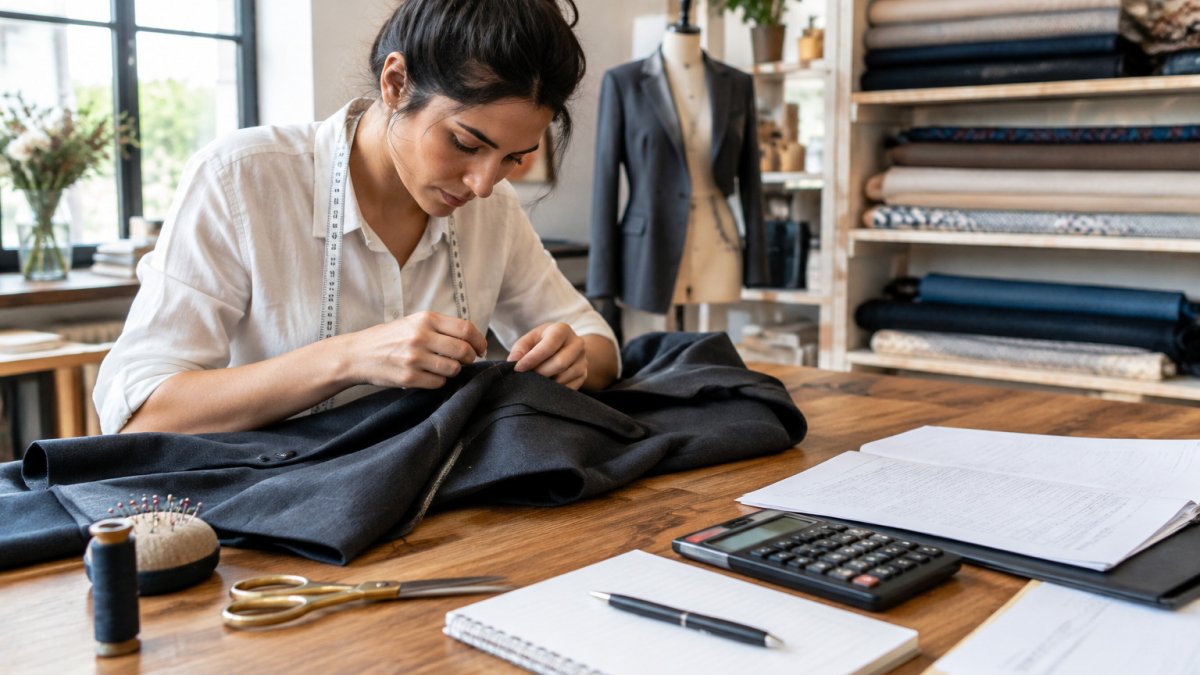
Independent designer pieces cost more because the price reflects a different production model, not just a label. When a small label makes a garment by hand from better materials, every stage costs more per unit than it does in a factory built for volume.
Two things drive the difference most: materials and labor. The price of a garment is built from the cost of fabric, the time it takes to construct, and the people who do the work. Mass-market brands spread those costs across millions of units. Independent makers rarely have that luxury.
Fabric Quality and Material Sourcing
Fabric is usually the first place the cost gap shows up. Independent designers often buy smaller quantities, which means they lose the bulk discounts that large retailers negotiate. Natural fibers and heavier weights generally cost more than synthetic blends, and that difference can pass into the retail price.
Garment Construction, Sewing Quality and Skilled Labor
Construction is where much of the hidden value sits. Lined jackets, French seams, hand-finished hems and properly set sleeves all take time, and time is labor. A skilled sewer working on a single garment can spend hours on work that a factory line completes in minutes. Independent designers also tend to pay their makers more, and fair wages are a real cost that mass-market brands often push down the supply chain.
A Transparent Breakdown of a Garment's Retail Price
Retail price is not a single number tied to one cost. It is the sum of several layers, and most shoppers never see them. A garment's retail price generally reflects several layers, including materials, labor, design and development, overhead, marketing, distribution, and margin. Each layer stacks on the one below it.
Because independent brands spread fixed costs across fewer units, each layer tends to weigh more heavily per piece. That is the part of the equation that rarely gets explained to shoppers.
Design, Pattern-Making and Sampling Costs
Before a single piece is sold, a designer pays for pattern-making and sampling. A pattern is drafted, a sample is cut and sewn, the fit is tested on a body, and then the pattern is revised. This cycle can repeat several times for a single style. Large brands amortize this work over thousands of units. An independent label may need to recover the same development cost from a run of a few dozen pieces, which raises the price per garment.
Small Production Runs, Minimum Orders and Economies of Scale
Economies of scale explain much of the gap. Factories set minimum order quantities, and small labels often cannot meet them without tying up significant cash in inventory. Smaller runs also lose the unit-cost savings that come with volume. The result is that independent designers often pay more per unit for the same inputs, and they pass that cost on because they cannot make it up in volume.
The price layers below are the ones the article describes, and each one tends to weigh more heavily on an independent label's piece.
| Price layer | What it covers | Why it weighs more for independents |
|---|---|---|
| Materials | Fabric cost | Smaller orders lose bulk discounts |
| Labor | Time and skilled construction | Skilled makers spend hours on hand finishing |
| Design and development | Pattern-making and sampling | Fewer units to spread development cost across |
| Overhead | Fixed business costs | Spread across fewer pieces |
| Marketing | Advertising and brand costs | Typically lower without luxury-scale budgets |
| Distribution and margin | Wholesale and retail margins | Each layer stacks on the one below |
How Much Handcrafted Clothes Cost to Make and Why It Varies
Handcrafted garments do not share one cost structure, and the variation is larger than most shoppers expect.
The first variable is time per construction step.
The second variable is who does the work and how they are paid.
The third variable is finishing. Hand-rolled hems, bound seams, hand-set linings, and pick-stitched edges are slow. They are also the details that determine how a garment wears over years.
The fourth variable is tooling and setup.
Watch out: a high price does not guarantee handcraft. Some brands use the language of handwork while relying on fused construction and machine finishing.
This variation is why two handcrafted pieces at similar prices can differ so much in quality. The price tells you about the inputs, but only careful inspection tells you whether those inputs were used well.
Independent Designer Fashion vs Luxury Fashion: Where the Price Differs
Independent designer fashion and luxury fashion are often grouped together, but they price differently. Luxury houses carry heavy brand premiums, large retail footprints and significant advertising budgets, and those costs are built into the sticker price.
That distinction matters when you compare value. A higher price from an independent maker may reflect the real cost of materials and labor, while a higher price from a luxury house may reflect the name on the label. Our advice is to ask what the price is paying for, and to judge the garment on its fabric, construction and fit.
Using a Clothing Markup Calculator and Judging Value Before You Buy
A markup calculator is a rough tool, not a verdict.
The more useful exercise is to separate the layers of a price and ask which ones you are willing to pay for. Materials and labor are production costs. Sampling and pattern-making are development costs.
A practical pre-purchase check, in order:
- Fabric content and weight. Read the fiber composition and, where listed, the fabric weight. Natural fibers and heavier weights generally cost more per meter and tend to hold shape longer. A high price with a thin synthetic blend deserves scrutiny.
- Seams and seam allowances. Turn the garment inside out. Look for finished seam allowances (French, bound, or flat-felled) rather than raw or lightly serged edges. Check that seam allowances are wide enough to allow alteration.
- Interlining and structure. In tailored pieces, feel whether the front panel has a floating canvas or a fused interlining. Canvas takes more labor and tends to drape and age better; fusing is faster and cheaper.
- Finishing details. Buttonholes, hems, and linings are where handwork shows. Hand-finished buttonholes and hand-set linings are slow and visible; machine imitations are not equivalent.
- Fit and alteration potential. A piece that fits well off the rack or can be altered cheaply is worth more than one that needs expensive rework.
- Care label. A care label that demands specialist cleaning adds to the true cost of ownership and should factor into your decision.
Then run the cost-per-wear test with realistic numbers. A higher-priced coat worn often can cost less per wear than a cheaper top worn rarely.
Watch out: cost per wear can be used to justify any purchase after the fact.
Price alone does not tell you whether a piece is good value. How long it lasts, how often you wear it, and whether the construction justifies the materials does.
Booking a Concierge Consultation to Find Pieces That Justify the Price
If you want help deciding which pieces are worth the investment, ENIGMAE's dedicated concierge support can guide you. Our concierge team can talk through your lifestyle and the kinds of pieces you are looking for.
Pricing for specific pieces depends on the item and the supplier, so please check the product page or contact our concierge team for current prices. Explore the curated collection, book a consultation, and see which pieces justify the investment for the way you live. Get started with ENIGMAE and find pieces that reflect your purposeful style.
Frequently Asked Questions
Why do independent designer clothes cost more than mass-market fashion?
Independent designers usually pay more per unit for fabric because they buy in small quantities without the volume discounts large retailers negotiate. Their garments are often cut and sewn in smaller workshops by skilled workers paid fair wages, and production runs are short, so design, sampling and pattern-making costs are spread over fewer pieces. Mass-market brands spread the same kinds of costs across millions of units.
Is a higher price a sign of better quality in designer clothing?
Not always. A higher price can reflect fabric, construction, labor and small-batch production, but it can also reflect brand name and marketing. Research on this point does not establish a reliable quality comparison between designer and non-designer garments. Check the fabric composition, look at the seams and hems, examine how linings and closures are finished, and test fit in person or through a retailer with clear return terms. Judging the piece itself is more reliable than judging by price alone.
What is the markup on clothing, and does it explain the price of independent pieces?
Markup is the difference between what a retailer pays for a garment and the price it sells for, usually expressed as a multiple of cost. Wholesale-to-retail markups vary widely by brand, category and channel, and the research supplied does not give a verified typical figure for independent designers, so no specific percentage is stated here. Markup covers overhead, marketing, distribution and returns as well as profit. Ask any brand for its pricing approach and compare it against your own budget.
How do I use a clothing markup calculator to judge a price?
A clothing markup calculator takes a known cost of goods and a target markup or margin and returns the retail price, or the reverse. To use one, you need an estimate of the garment's production cost, which you will rarely have as a shopper. Treat calculator results as a way to test assumptions, such as how much overhead a small brand might carry, rather than as proof of what a brand is earning. Pricing depends on quantity, dates and delivery terms, so check current prices directly with the retailer.